


The Savoy London — 2026 Review
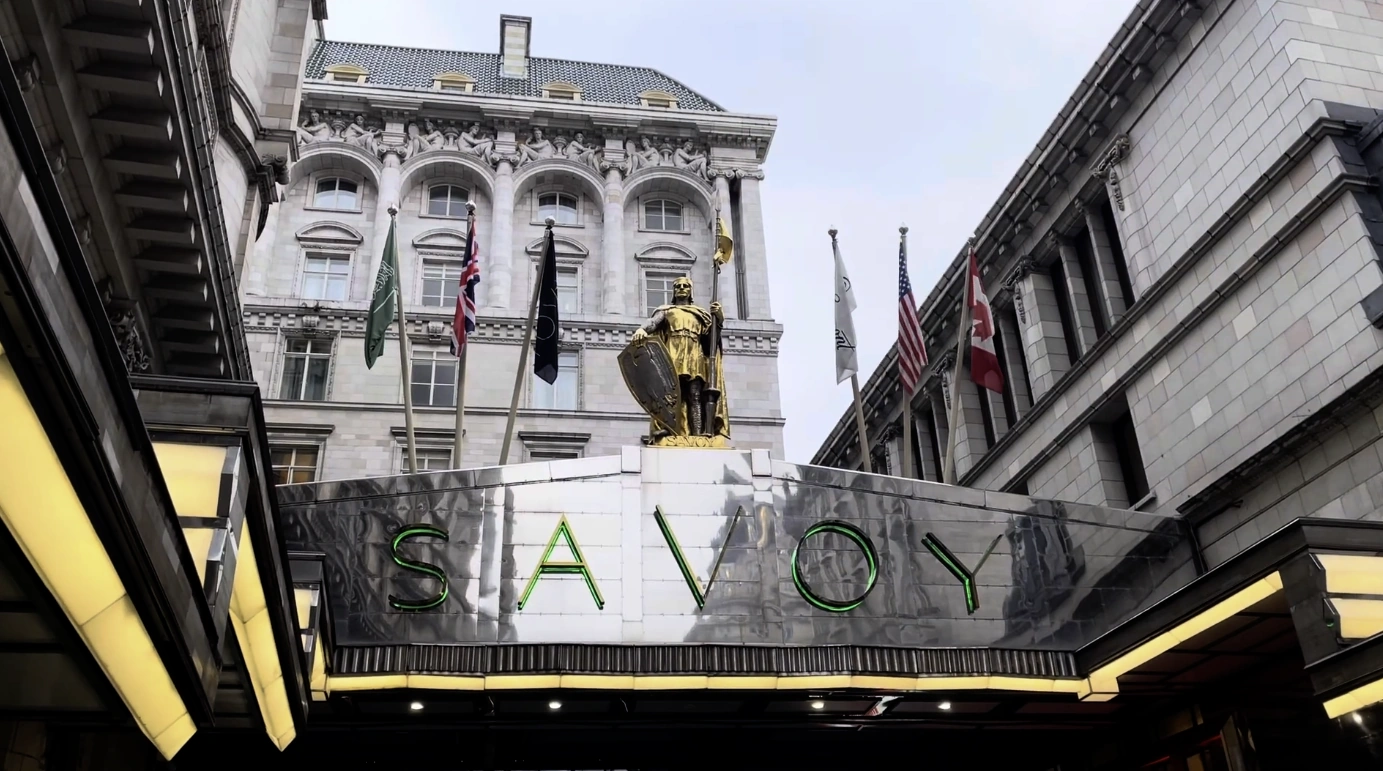
The Savoy London is one of the very few hotels in the world where the building performs for you, not the other way around. Most grand hotels ask something of their guests: the right clothes, the right manner, the right degree of visible appreciation. The Savoy does not seem to need anything from you. It has been here since 1889. It has seen everything. By the time I was on my second drink at the American Bar on the first evening — the room doing what it always does, which is make you feel the evening has real stakes — that observation had already settled into fact.
Richard D’Oyly Carte built it on profits from Gilbert and Sullivan productions at the Savoy Theatre next door, and from opening night on 6 August 1889 it operated with a confidence bordering on arrogance: electric lighting when everywhere else was still gas, electric lifts — known as “ascending rooms” — when the concept was still a novelty, en-suite bathrooms in most rooms when the idea barely existed. It lost money in its first six months, which led D’Oyly Carte to bring in César Ritz as General Manager and Auguste Escoffier as chef — a pairing that would define European hospitality for a generation. Both were sacked in 1898 for fraud and embezzlement, Ritz going on to open the Hotel Ritz the same year, Escoffier leaving behind Pêches Melba and Melba Toast as incidental legacies. In 1920, a bartender named Harry Craddock arrived at the American Bar having fled US Prohibition. By 1930 the hotel had commissioned him to compile The Savoy Cocktail Book — 750 recipes, still in print, for which Craddock never earned a penny. The hotel closed for three years in 2007 for its first ever restoration, reopening at exactly 10:10am on 10 October 2010 — the timing deliberate, the symbolism unmistakable. Stephen Fry was first through the door. Prince Charles and owner Prince Alwalid bin Talal held the official opening ceremony on 2 November 2010. The whole thing came in a year and a half late and £120 million over its original budget. That is also a very Savoy story.
The Savoy London has been open since 6 August 1889, closed once in its history for a three-year restoration that cost £220 million and came in a year and a half late, and reopened at exactly 10:10am on 10 October 2010 with Stephen Fry as its first guest. It is currently mid-way through a further £45 million room refurbishment running through to 2027. It remains the only hotel in the city where you can wake up to the Thames, drink the best Corpse Reviver of your life before dinner, and eat beef Wellington in the room where Churchill had standing reservations. It doesn’t try to be London’s most iconic hotel. It simply is.

Quick Menu
The Savoy London — 2026 Review
-
At a GlanceKey facts · prices · awards · check-in times
-
Location & How To Get ThereThe Strand, Covent Garden & Embankment — access from every airport
-
Rooms & Suite CategoriesWhy the Thames view changes everything — and which rooms deliver it
-
Dining — The Grill, American Bar & BeyondThe bar that wrote the modern cocktail. The Grill that Churchill treated as his office.
-
Pool, Spa & WellnessFairmont Spa · Indoor pool · Fitness centre
-
Pricing & ValueRates, inclusions, comparisons & worth it?
-
FAQ — Views, Breakfast, Parking & SpaAll your practical questions answered
-
JP’s Verdict & ScoreWho should book — and who shouldn’t
AT A GLANCE
Location & How To Get There
The Savoy sits on the Strand at the precise point where central London’s theatre district meets the river. It’s not Mayfair’s quiet money or Marylebone’s residential ease — this is London at full operational pitch, and the hotel’s position reflects that. Covent Garden is a five-minute walk north, the Royal Opera House ten minutes. The Embankment is ninety seconds south on foot, with the Thames in front of you and the Hungerford Bridge walkway leading toward the South Bank. The National Theatre, Tate Modern, and Borough Market are all reachable in under twenty minutes without a taxi. For anyone who wants to be in the middle of the city’s cultural life — genuinely in it, not adjacent to it — the Savoy’s address is the strongest argument it has.
For tube access: Charing Cross station is a five-minute walk, giving you the Bakerloo and Northern lines. Embankment station (Circle, District, Bakerloo, Northern) is four minutes. Temple station on the District and Circle lines is six minutes in the other direction. The coverage is exceptional — you can reach virtually anywhere in central London within twenty minutes from the front door. For international arrivals, the Elizabeth line from Heathrow to Paddington takes around 15 minutes, then a 15-minute taxi to the hotel. Total journey: 35 to 45 minutes from terminal. The hotel concierge can arrange car service from any London terminal.
One logistical note worth knowing: Savoy Court, the hotel’s private approach road, is the only street in the United Kingdom where traffic drives on the right. This was established so that passengers alighting from horse-drawn carriages could step directly onto the pavement on the hotel side. It remains today, which means arriving guests have the unusual experience of a car sweeping left into a building — a small theatre that signals immediately that normal rules are suspended.
Rooms & Suite Categories
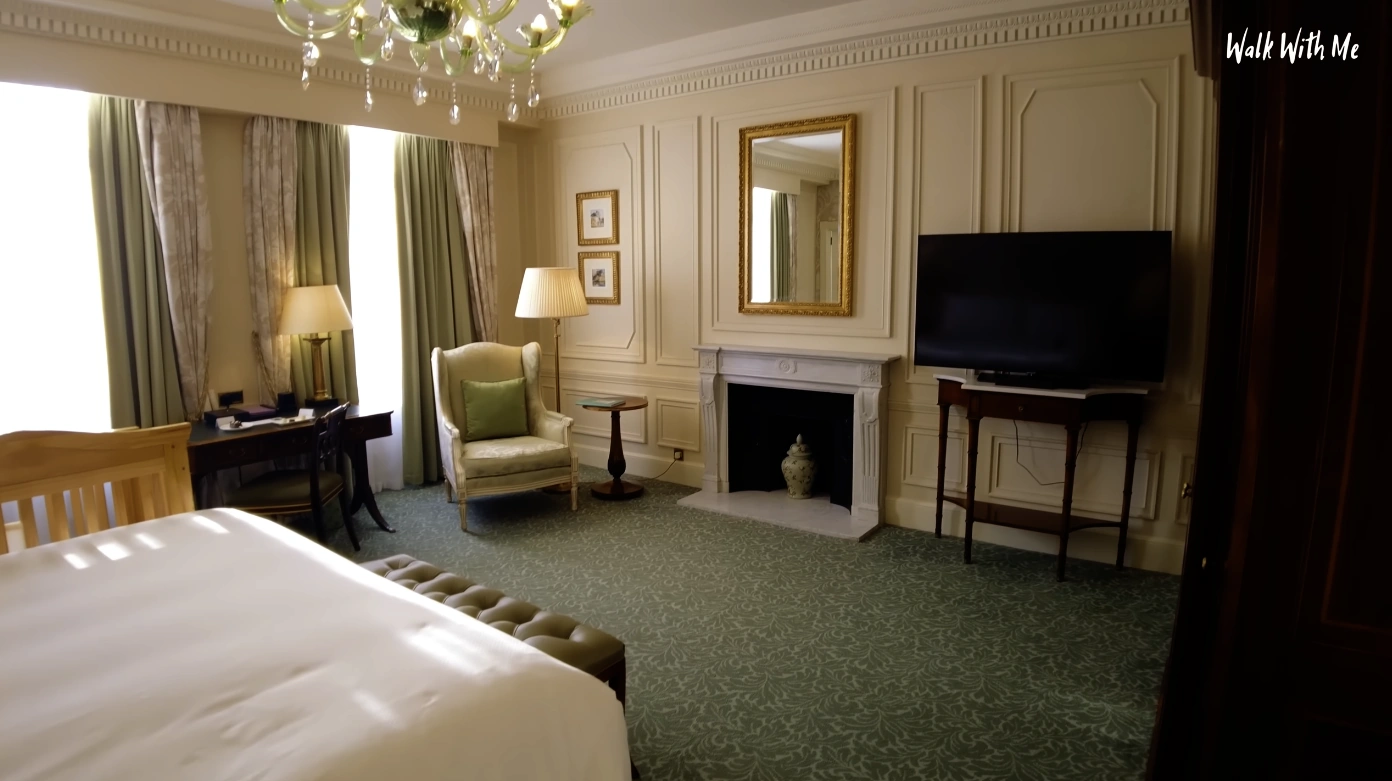
The Savoy has 267 rooms and suites divided across two architecturally distinct wings: the Edwardian wing, which runs toward the Strand, and the Art Deco wing, which faces the river. This is not merely a design detail — it is the most consequential booking decision you will make. The Edwardian wing is warm, traditionally English, rich with period detail. The Art Deco wing is sharper, more graphic, more dramatic. And then there is the matter of the Thames. River-facing rooms in the Savoy are among the finest hotel rooms in London. The view across to the South Bank, the bridges, the light on the water — these are not incidental. They are the reason to book.
Renovation note (2025–2027): A phased refurbishment of rooms and suites is currently underway. The first newly-renovated rooms became available from mid-2025, with the programme continuing through to 2027. Depending on your booking date and category, you may receive a renovated room or an unrenovated one. If this matters to you, call the hotel directly and ask — it is a reasonable question and they will know which rooms are currently finished.
Room categories & prices — 2026
JP recommends
The Two Wings — Edwardian vs. Art Deco

The decision between the Edwardian and Art Deco wings is genuinely worth making consciously. The Edwardian rooms — warm cream and gold, traditional English proportions, the kind of room that feels like it was furnished by someone who had read widely and travelled well — sit in the wing closest to the Strand. The Art Deco rooms are sharper: graphic patterns, bolder colour, a geometry that feels designed rather than accumulated. Both are excellent. Which suits you depends on whether you respond more to tradition or to modernity. What unites them is the finish quality throughout: marble bathrooms with Hansgrohe rainfall showers and a full bath in most categories, Molton Brown amenities, properly made beds. The hotel was restored at a cost of £220 million between 2007 and 2010, and a further £45 million room refurbishment programme began in August 2024 and runs through to 2027. Rooms come with a complimentary mini bar concealed behind mahogany cabinetry. It is modest by the standards of the rate, but it is there and it is included. This is not a grand hotel living on heritage alone.
One practical note: on the Strand-facing side, particularly in lower floors, street noise is present at certain hours. The Savoy’s position on one of London’s main thoroughfares is a geographic fact. Rooms on upper floors and the river-facing side are dramatically quieter. If you’re a light sleeper or have an early meeting, request upper floors when booking.
The Thames View — Why It Changes Everything

I want to be direct about this: the Thames-facing rooms at The Savoy are among the best hotel rooms in London at any price. Waking to the river — the bridges, the South Bank’s low skyline, the early morning light moving across the water — is an experience that no interior, however beautifully restored, can replicate. The Savoy’s position on the Embankment side gives it something that Claridge’s, the Connaught, and even the Langham simply cannot offer. When you’re making your booking, the step up from a Strand-facing Classic to a Thames-facing Superior is the single most worthwhile upgrade in this hotel. Do not book The Savoy and look at a wall.
“The Thames-facing rooms at The Savoy are among the best hotel rooms in London at any price. Waking to the river — the bridges, the South Bank, the morning light on the water — is something no interior, however beautiful, can replicate.”
Suites & Butler Service
The Savoy’s suite programme runs from Junior Suites to the Royal Suite — a multi-room configuration that has hosted the kind of guests whose names appear in history books. Butler service is available across the full suite tier and operates with the seriousness you’d expect from a property of this type: restaurant bookings, unpacking and packing on request, in-suite dining coordination, and an insider knowledge of the city that a good hotel butler should have and a bad one pretends to. The River Suites on the upper floors with full-width river views represent the clearest case for suite-level spend in the London five-star market — there are few rooms in this city where the combination of interior and view justifies the rate as cleanly as these do.
What I’d Flag
Two things in the room that sit oddly at this price point. First, the chandeliers: what appears at first glance to be a statement fixture is, on closer inspection, largely plastic — the frame dressed with crystal-style embellishments rather than the real thing. It’s a decorating decision that reads as incongruous in a hotel that otherwise executes on detail. Second, the plug sockets. The bedside sockets use old-fashioned rounded plugs, which means if you want to charge your phone you will likely need to unplug a lamp. There is no accessible socket near the mirror for anyone who needs one. For a hotel at this rate, this is a genuine daily inconvenience rather than a minor quirk.
Classic Rooms on the Strand-facing side at entry rates are the weakest proposition in the portfolio. You’re paying five-star prices for a room that, without the river and without the additional space of a Superior or Deluxe, relies heavily on the building’s cachet to justify the rate. The Savoy is a hotel that rewards investment in room category. At Classic level facing the Strand, the value equation requires you to care about the name on the door more than the room behind it. Some people do. That’s a legitimate choice. Just make it consciously.
Where to stay
We may earn a commission if you book via these links, at no extra cost to you. We only recommend hotels we have personally stayed in and reviewed.
Dining & Restaurants
The Savoy’s food and drink programme is, in aggregate, the strongest case for the hotel outside the river views. Six distinct venues — the Grill, Restaurant 1890, The River Restaurant, Gallery, the American Bar, and the Beaufort Bar — operate at genuinely different registers and serve genuinely different purposes. No single hotel in London covers this much ground as consistently. Here is the full breakdown.

JP’s Experience — Dining at The Savoy
The American Bar — The Bar That Wrote the Book

In 1920 Harry Craddock arrived at the American Bar having fled US Prohibition. By 1926 he was head bartender, and by 1930 the hotel had commissioned him to compile The Savoy Cocktail Book — 750 recipes, still in print today, for which Craddock never earned a penny. The White Lady and the Corpse Reviver No. 2 are his inventions. The Hanky Panky was created by his predecessor Ada Coleman — the first woman to lead the American Bar — and remains on the current programme. In 1927, Craddock buried a White Lady cocktail sealed in a shaker inside a wall of the bar. It has never been found. That history is present in the room in a way that doesn’t feel like a museum. The cocktails are made with the kind of precision that a bar with this specific legacy is obligated to maintain. The ice cubes are branded with the Savoy name. One item on the current programme is worth seeking specifically: a cocktail whose recipe was sent to space by NASA, connected to a letter from Neil Armstrong. The staff know the story. It is exactly the kind of thing the American Bar should be doing.
The bar is also, by London hotel bar standards, relatively quiet in the sense that matters: conversations don’t compete with music. This is rarer than it should be.
“The American Bar is small, precise, and historically loaded. The cocktails are made with the kind of care that a bar with this specific legacy is obligated to maintain. I went three times in three nights. None of it felt excessive.”
The Savoy Grill — A Great London Dining Room

The Savoy Grill has been feeding London’s establishment since 1889, and the names that have passed through it — Churchill, Chaplin, Sinatra, Thatcher — are less a marketing exercise than a geological record of the city’s social life. The current operation is run under Gordon Ramsay’s hospitality group, and it functions as a serious British restaurant with a menu built around the classics done well: beef Wellington, Dover sole, the trolley. The Beef Wellington here is the correct one to order — not because it’s a cliché but because this kitchen executes it with the kind of confidence that only comes from making it hundreds of times.
The room itself is worth noting: high ceilings, wood panelling, the kind of dining room where transactions happen because the environment was designed for them. Business diners in particular will find The Grill functions almost perfectly for client entertainment. One honest critique: the Grill can feel slightly formal to the point of stiff on quieter weekday lunches. On a busy evening, it’s one of the great London experiences. Book the evening.
The River Restaurant by Gordon Ramsay

The River Restaurant is The Savoy’s seafood-focused dining room under the Gordon Ramsay group, built around the best shellfish and seafood the UK produces: fresh oysters, ceviche, caviar, grilled Cornish lobster, whole day-boat fish. The menu is more relaxed in register than the Grill or Restaurant 1890 — this is the room for a long lunch or an easy dinner where the produce does the work. The tandoori monkfish curry is a dish that appears on tables throughout service for a reason. The wine list leans white Burgundy and Champagne, which makes obvious sense.
Gallery — Afternoon Tea & All-Day Dining

For most of its 135-year history, this room was known as the Thames Foyer. It closed on 21 August 2024 and reopened on 23 November 2024 as Gallery, following a complete transformation by London-based design studio BradyWilliams. The atrium remains as the defining architectural feature, now with modernised lighting that shifts the atmosphere from morning through to late evening. The new design adds black and white marble, fluted glass, gold-embossed mirrors, and leather seating in soft pink, warm ochre, and heritage tan. Three months from closed to reopened is fast for a renovation of this scale, and the result shows the investment.
Gallery operates as a genuine all-day venue: breakfast, lunch, afternoon tea, cocktail hour, dinner, and late-night drinks. The afternoon tea — at around £90 per person — remains the anchor of the programme. The dedicated scone shop Scoff, which opened alongside Gallery and serves freshly-baked scones daily from 12:04pm, is a small but characterful addition. Book two to three weeks ahead for any weekend afternoon tea sitting.
Simpson’s-in-the-Strand — Delayed, Still Anticipated
Worth flagging for anyone booking a stay now: Simpson’s-in-the-Strand, the grand dining room adjacent to The Savoy that has been serving roast beef from a silver trolley since 1828, is reopening under Jeremy King Restaurants. The reopening has been set back by a year of delays and no confirmed date is currently public. Check current status before booking if this is part of your itinerary.
The Beaufort Bar & Restaurant 1890
The Beaufort Bar — occupying what was formerly the hotel’s cabaret stage — operates in an entirely different register from the American Bar: black and gold, theatrical, champagne-forward, designed for occasion rather than conversation. If the American Bar is the room for a serious drink and a long evening, the Beaufort Bar is the room for a celebration.
Restaurant 1890 by Gordon Ramsay is The Savoy’s Michelin-starred fine dining restaurant, named for the year Auguste Escoffier arrived at the hotel as its founding chef. It’s a tasting menu-only operation — intimate, precise, overlooking Savoy Court. Two honest notes: the portion sizes are genuinely small even by tasting menu standards. And the wine is served in glass measuring vessels rather than conventional wine glasses — a deliberate presentation choice that divides opinion cleanly. If flexibility matters, the Grill serves you better.
Pool, Spa & Wellness
The Fairmont Spa at The Savoy is a well-run, considered wellness operation — but it is, by the standards of the building around it, compact. The indoor pool is heated and attractive without being architecturally dramatic. None of it is the reason to book The Savoy, and presenting it otherwise would be dishonest. What it is: a genuinely good hotel spa in a city where many five-stars have no pool at all.
 Facilities at a glance
An Honest Assessment
To be clear about what the Fairmont Spa is and isn’t. It is a professionally run spa with a competent treatment team, proper sauna and steam facilities, and a pool that functions well and is never unpleasantly crowded in my experience. It is not architecturally remarkable — if you’re arriving from a stay that included something like The Langham’s Victorian vault pool, the comparison will be obvious. If spa and wellness are central to your London itinerary, the Savoy will serve you adequately and pleasantly. If they are the main event, direct your budget to a property where the spa is the defining architectural statement.
Pricing & Value
Strong value at Thames View level and above — tighter in entry rooms. The river, the American Bar, and The Savoy Grill together make a compelling case. But you need to book the right room. At Classic Strand-facing rates, the premium over a well-run four-star requires you to value the name heavily. At Thames View level, it earns every pound.
What’s included vs extra- Wi-Fi throughout
- Indoor pool access for hotel guests
- 24-hour fitness centre access
- Nespresso machine in room
- Butler service (suite categories)
- Breakfast (~£45 per person)
- Spa treatments
- Gallery afternoon tea (~£90 per person)
- Airport transfers (hotel car service)
- Discretionary service charge at checkout
| Hotel | The Savoy Reviewed | Claridge’s | The Connaught | The Langham |
| Area | Strand / Covent Garden | Mayfair | Mayfair | Marylebone |
| Entry price | From ~£650 | From £800 | From £900 | From £500 |
| Pool | Yes (indoor) | No | No | Yes — 16m vault |
| River view | Yes — Thames | No | No | No |
| Best bar | ★★★★★ American Bar | ★★★★ Fumoir | ★★★★★ Connaught Bar | ★★★★★ Artesian |
| JP’s score | 8.7 / 10 | 9.5 / 10 | 7.5 / 10 | 8.8 / 10 |
Is The Savoy Worth the Money?
At Thames View level and above: yes, clearly. The river rooms are among the finest hotel rooms in London at any price, the American Bar is irreplaceable, and The Savoy Grill is one of the great London dining rooms. That combination — particularly if you are staying for a special occasion, a business trip where the atmosphere of the place matters, or simply because you have decided that London deserves to be done properly — justifies the rate with room to spare.
At Classic Strand-facing level, the calculation is harder. You’re paying a significant premium for a hotel whose signature assets — the river, the bar, the Grill — are all accessible without the room upgrade. The name is famous. The building is extraordinary. But the entry-level room itself, on the Strand side, does not deliver the full Savoy experience in the way that spending another £200 a night on a Thames-facing Superior unambiguously does. My recommendation: save the money elsewhere and put it into the room category here.
“Breakfast is not included in standard rates — add approximately £45 per person per day. Bookings through preferred travel advisors typically include daily breakfast and a room upgrade. At this pricing, that changes the value equation considerably.”
When to Book for Best Value
January through March are the quietest months and offer the most competitive rates — the hotel operates at its most relaxed during this window, spa availability opens up, and The Grill is easier to book without weeks of lead time. May through June and September through October represent the sweet spots for London weather and the hotel’s full programme. Summer peak (July and August) sees rates at their highest and the lobby at its busiest. For theatre season, book the autumn — The Savoy’s proximity to the West End makes a stay here feel purposefully curated rather than merely convenient.
Where to stay
We may earn a commission if you book via these links, at no extra cost to you. We only recommend hotels we have personally stayed in and reviewed.
FAQ — The Savoy London
The most common questions about The Savoy London answered directly — this review is based on three paid nights in September 2025 and multiple previous visits to the American Bar and Grill.
Is afternoon tea at The Savoy worth it?
Yes — if you’re clear about what you’re paying for. At around £90 per person, the food is excellent: properly made finger sandwiches, warm scones, and pastries from a serious kitchen. The setting in Gallery, with its glass atrium and live pianist, is one of the finest afternoon tea rooms in London. You’re paying for the room and the ritual as much as the food. If that trade appeals, it’s worth every pound. Book two to three weeks ahead for weekends.
What is the difference between the Edwardian and Art Deco rooms?
The Edwardian wing — closest to the Strand — is warmer and more traditionally English: cream and gold tones, period detailing, classic proportions. The Art Deco wing is sharper and more graphic: bold geometric patterns, stronger colour, a designed-rather-than-accumulated feel. Both are excellent. The more important decision is whether your room faces the Thames or the Strand — the view matters far more than the decorative style.
Is The Savoy London worth the money?
At Thames View level and above: yes. The river rooms are among London’s finest hotel rooms at any price, the American Bar is irreplaceable, and The Savoy Grill is one of the great London dining rooms. At Classic Strand-facing level, the value is tighter — you’re paying for the institution more than the room itself. Book the Thames View and don’t look back.
What is Restaurant 1890 at The Savoy?
Restaurant 1890 by Gordon Ramsay is The Savoy’s Michelin-starred fine dining restaurant, named for the year Auguste Escoffier first arrived at the hotel. It’s a tasting menu-only experience overlooking Savoy Court — intimate, precise, and very different in register from the Grill. It’s worth booking if a formal tasting menu is what you’re after; the Grill remains the better choice for client entertaining or a celebratory dinner with more flexibility.
Does The Savoy have parking?
Yes — valet parking is available directly from the hotel entrance on Savoy Court, no advance booking required. Rates start at £22.50 for up to 2 hours and rise to £70 for overnight. The hotel also has in-and-out privileges. For central London, this is a reasonable option — though the tube access from Charing Cross and Embankment stations (both under 6 minutes on foot) makes driving unnecessary for most stays.
Does The Savoy allow dogs?
Yes, with conditions. Dogs under 25lbs / 11kg are welcome at a charge of £25 per day. Pets cannot be left unattended in rooms and are not permitted in the hotel’s bars or restaurants (registered service animals excepted). If you’re travelling with a larger dog, The Savoy is not the right choice — the weight limit is enforced.
Can non-guests use the pool and spa at The Savoy?
Yes. Non-residents can purchase a day pass at £85 per person, which covers access to the pool, sauna, steam room, and gym. Pool access is also included for non-residents who book a Beauty & Fitness treatment. Pool hours are weekdays 7am–9pm, weekends and bank holidays 8am–8pm. Hotel guests have complimentary access included in their room rate.
Does The Savoy include breakfast?
Not in standard rates. Breakfast in Gallery is approximately £45 per person and is charged separately. Bookings through Leading Hotels of the World preferred advisors typically include daily breakfast as a standard benefit — at this pricing, that inclusion represents meaningful value and is worth seeking when you book.
Is The Savoy good for business travel?
Yes — particularly for client entertainment. The Savoy Grill is one of London’s finest rooms for a business dinner: serious table spacing, discreet service, and institutional gravitas that impresses without needing explanation. The American Bar works well for drinks meetings. Wi-Fi is reliable throughout. The honest caveat: there is no Club Lounge equivalent, which business travellers accustomed to private breakfast and a quiet working space will notice.
How do I get the best rate at The Savoy?
Book through a Leading Hotels of the World preferred advisor — this typically adds daily breakfast, a room upgrade on arrival, and hotel credit at no extra cost. January through March are the lowest-rate months. Fairmont’s loyalty programme (ALL — Accor Live Limitless) adds value for frequent Fairmont guests. Avoid peak summer if your dates are flexible.
Is It Right For You?
- Thames-facing rooms — no other London hotel at this tier sits on the river like this
- The American Bar — the bar that wrote the book on cocktails, literally
- The Savoy Grill — one of London’s great dining rooms, still at full operational strength
- A significant occasion — few hotels in the world carry this kind of institutional weight
- Theatre and arts visits — the West End, Royal Opera House, and South Bank are all on your doorstep
- 135 years of operational history — the definition of a proven institution
- A quiet private retreat — lobby energy at peak times is grand occasion, not sanctuary
- An architecturally remarkable spa — the Fairmont Spa is good, not exceptional
- A Club Lounge with private breakfast and working space — The Savoy has no equivalent
- Breakfast included — not in standard rates, and at ~£45 per person it adds up
- Entry-level Strand rooms — Classic facing the street requires valuing the name over the room
Final Verdict
135 Years On. The River Is Still There.
There are hotels that become institutions through quality. There are institutions that survive on name alone. The Savoy, at its best, is the first kind — and understanding where that best lives is the practical intelligence this review is meant to give you. It lives in the Thames-facing rooms on upper floors, where the river at dawn is a view no amount of interior design spending replicates. It lives in the American Bar, which is simply one of the great rooms in London, full stop. It lives in The Savoy Grill on a busy evening, when the room operates at the pace and volume it was designed for and you understand immediately why Churchill ate here instead of going home.
Where the institution is merely coasting: the entry rooms on the Strand side, which require you to value the name more than the room. The spa, which is competent but not the reason to come. The high-volume lobby during peak summer, which is grand occasion rather than private retreat. These are not failures. They are honest limitations. The Savoy is not trying to be the quietest or the most intimate hotel in London. It is trying to be the most significant. In the rooms that matter, with the bar it has always had, it succeeds.
Where to stay
We may earn a commission if you book via these links, at no extra cost to you. We only recommend hotels we have personally stayed in and reviewed.
I’m Italian, and I split my time between London and Málaga. That combination — northern European rigour, southern European instinct — shapes how I think about a hotel or a meal. I review both because I genuinely love them, not because someone gave me a press trip. I always pay my own way and always stay at least one night before writing a hotel review. I’ve eaten in a lot of Michelin-starred restaurants and slept in a lot of expensive rooms, and neither has made me easier to impress.

The Connaught London Review: Mayfair Grandeur & the Legendary Aman Spa
The Connaught is the quiet master of Mayfair. It defines luxury not through flash, but [...]
Jan
The Dorchester London: Fresh Renovations & Timeless Controversy
The Dorchester Hotel in London is an iconic luxury landmark situated in the heart of [...]
Jan
Claridge’s London Hotel Review 2026: The £4,000 Truth Revealed
After a three-night stay costing over £4,000 at London's legendary Claridge's, the fundamental question remains: [...]
Jan

8 Best Luxury Hotels in London: Personally Reviewed & Compared
A local expert's 2026 guide to the 36 best luxury hotels in London. Compare 5-star [...]
Mar

The Ritz London: 2026 Luxury Hotel Review, Rooms & Dining Experiences
The Ritz London isn't just a hotel; it's a living legend. But in an era [...]
Jan

Best Hotel Restaurants London: A Foodie’s Guide to Luxury Stays & Dining
Discover London's finest luxury hotels where Michelin-starred chefs create unforgettable dining experiences. Your gourmet getaway [...]
Jan
Mandarin Oriental Hyde Park: The Complete Truth After My Stay
What does a 5-star legend truly deliver? My firsthand account separates the timeless luxury from [...]
Jan
